| Code | Slope angle (degrees) |
|---|---|
| Wheelable | |
| A | 0–3 |
| B | 4–7 |
| C | 8–15 |
| Hilly | |
| D | 16–20 |
| E | 21–25 |
| Steep | |
| F | 26–35 |
| G | >35 |
Appendix D — Classifying numeric measures
D.1 Setting and site
Many of the parameters described in Chapter 1 though to Chapter 7 are inherently categorical. Classifying the numeric measurements as well can be useful for efficient communication. However, in the absence of inherent groupings in these data, class boundaries need to be chosen carefully.
D.1.1 Slope classification
For most New Zealand soils communication, the Land Use Capability slope classes (Section D.1.1.1) are preferred because they are familiar to a wide audience. Other systems are included here as they may be more appropriate for specific applications.
D.1.1.1 Land Use Capability slope classes
The most commonly-used slope classification in New Zealand is the one associated with the Land Use Capability (LUC) framework. These classes were formulated primarily to support pastoral agriculture, and the class boundaries focus on slope as an activity limiter rather than an inherent landscape property. This means the classification can potentially underperform in landscapes where natural slopes are close to the class boundaries. This is acknowledged in the LUC handbook (Lynn et al. 2009) by the inclusion of various options for modifying slope class.
The class boundaries are reproduced from Table 26 of the LUC handbook in Table D.1. Some generalised groupings are also included; these are discussed in Appendix 1 of the LUC handbook but are not explicitly defined.
D.1.1.2 Natural Log classifications
Work by Speight (1971) promotes the use of slope classes with natural-log-derived limits on the basis that they come closest to a universal set of ‘characteristic slopes’. The limits proposed are shown in Table D.2. These classes are commonly used in Australian soil survey, and focus more on splitting up low-slope areas of the landscape, so they may be more useful for interpreting low-relief landscapes than the LUC slope classes.
| Code | Name | Slope angle (percent) | Slope angle (degrees) |
|---|---|---|---|
| LE | Level | 0 to ≤1 | 0 to ≤0.57 |
| VG | Very Gentle | >1 to ≤3 | >0.57 to ≤1.72 |
| GE | Gentle | >3 to ≤10 | >1.72 to ≤5.71 |
| MO | Moderate | >10 to ≤32 | >5.71 to ≤17.70 |
| ST | Steep | >32 to ≤56 | >17.70 to ≤29.25 |
| VS | Very Steep | >56 to ≤100 | >29.25 to ≤45.00 |
| PR | Precipitous | >100 to ≤300 | >45.00 to ≤71.60 |
| CL | Cliffed | >300 | >71.60 |
D.1.1.3 UN-FAO Classification
The following classification was offered by the UN-FAO’s Guidelines for Soil Description (UN-FAO 2006). The classes are highly discriminatory on low slopes but lump most steeper slopes into only two categories. As a result they may be of most use in irrigation planning.
| Code | Name | Slope angle (percent) | Slope angle (degrees) |
|---|---|---|---|
| 01 | Flat | 0 to ≤0.2 | 0.00 to ≤0.11 |
| 02 | Level | >0.2 to ≤0.5 | >0.11 to ≤0.29 |
| 03 | Nearly level | >0.5 to ≤1.0 | >0.29 to ≤0.57 |
| 04 | Very gently sloping | >1.0 to ≤2.0 | >0.57 to ≤1.15 |
| 05 | Gently sloping | >2 to ≤5 | >1.15 to ≤2.86 |
| 06 | Sloping | >5 to ≤10 | >2.86 to ≤5.71 |
| 07 | Strongly sloping | >10 to ≤15 | >5.71 to ≤8.53 |
| 08 | Moderately steep | >15 to ≤30 | >8.53 to ≤16.70 |
| 09 | Steep | >30 to ≤60 | >16.70 to ≤31.00 |
| 10 | Very steep | >60 | >31.00 |
| Source: UN-FAO (2006). | |||
D.1.1.4 Data-driven classifications
Where high-precision DEMs are available and the areal limits of landscapes are identified, data-driven slope classification is possible. This cannot be done universally: because the classification is an expression of local geomorphology, the area of interest must first be carefully delineated before proceeding. Classes defined in this way may be very useful in accurately defining landforms, but hard to convert to practical use.
D.1.2 Aspect classification
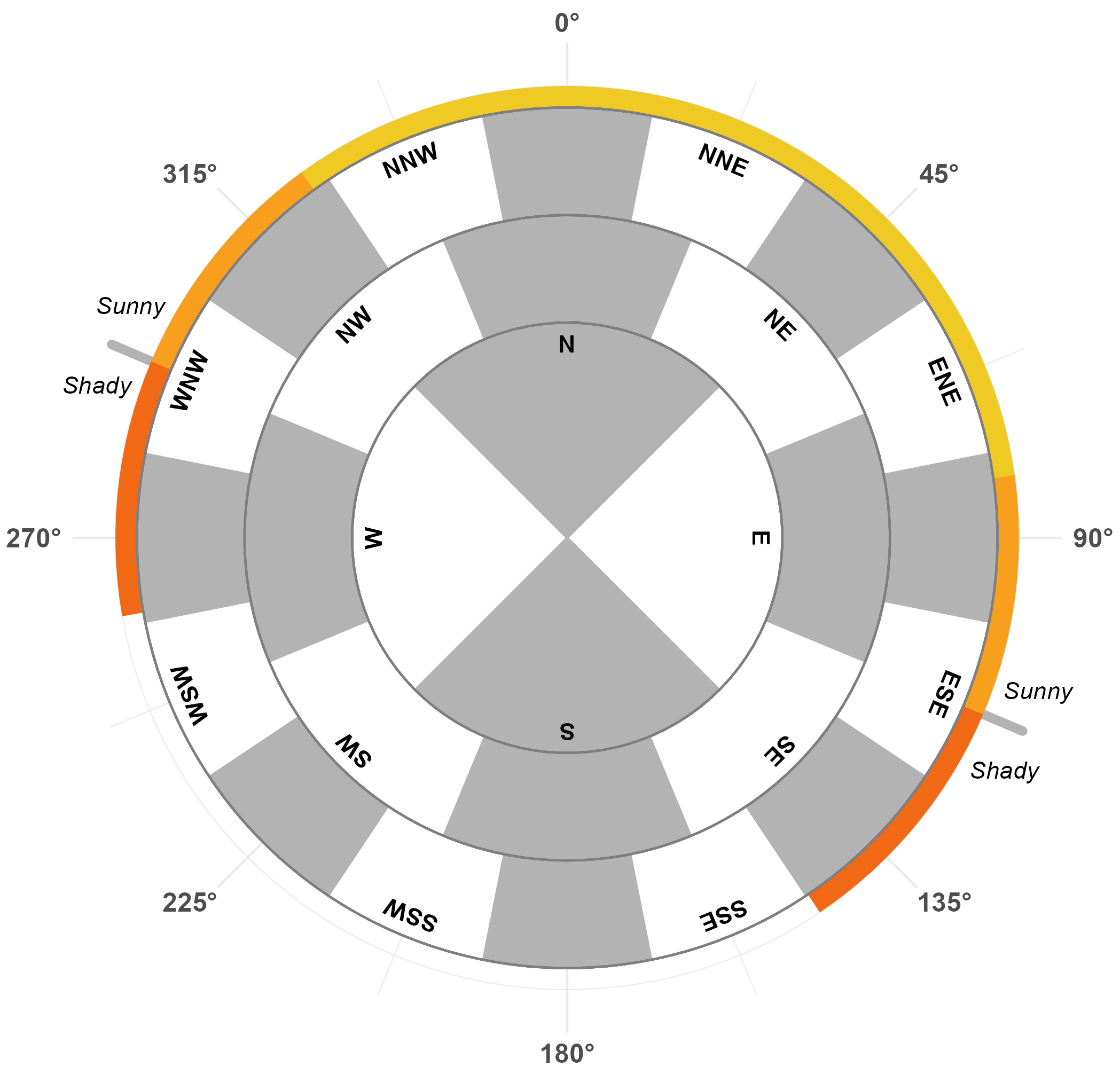
The broadest aspect classification available divides the landscape into flat/sunny/shady. In New Zealand, ‘sunny’ is roughly ‘north-facing’, adjusted for the earth’s axial tilt (23.44°), and the range of exposure varies with season. Daytime sun directions (‘azimuth’) in Wellington are highlighted in Figure D.1, where the narrowest yellow range corresponds to winter sun azimuth range (324° to 82°), and the widest dark orange range is the summer sun azimuth range (260° to 146°). These ranges vary only slightly in the north and south of the country.
For greater precision, numeric aspect data can be classified by cardinal compass direction, in 4, 8, or 16 divisions as needed. Do not forget to correct magnetic directions to true directions by accounting for declination.
D.1.3 Relief classification
The following classification system is used globally and has been developed over many years (see e.g. Hammond 1954; Löffler 1977; Brabyn 1998; Speight et al. 2024).
Relief classifications are scale-dependant; the ranges presented in Table D.4 are calculated by convention over a 600 m diameter window. The classification can be adjusted to a smaller or larger window size using the formula \(range_{new} = range_{old} × (window_{new} / window_{old})\), where all inputs are in metres.
| Code | Name | Range (m) | Average (m) |
|---|---|---|---|
| P | Extremely low | ≤9 | ~5 |
| R | Very Low | >9 to ≤30 | ~15 |
| L | Low | >30 to ≤90 | ~60 |
| M | Moderate | >90 to ≤150 | ~120 |
| H | High | >150 to ≤300 | ~200 |
| V | Very High | >300 | ~500 |
D.2 Profile
Classifying numeric profile data may be done for cross-compatibility with older data, or for summarised communications.
D.2.1 Size classes
D.2.1.1 Size classes for solid soil components
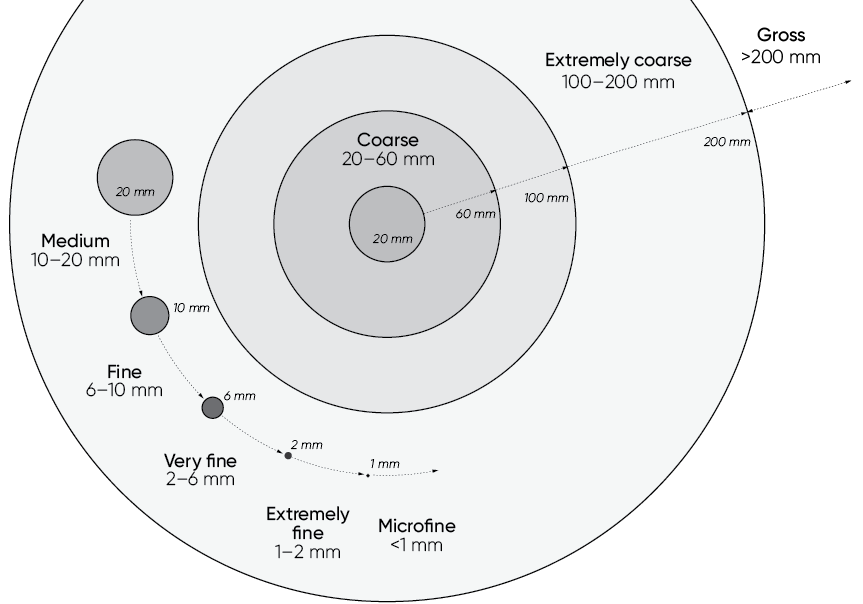
The following size classification can be applied to size data gathered for peds and other solid soil components.
| Code | Name | Size range (mm) |
|---|---|---|
| 1 | Microfine | <1 |
| 2 | Extremely fine | 1–2 |
| 3 | Very fine | 2–6 |
| 4 | Fine | 6–10 |
| 5 | Medium | 10–20 |
| 6 | Coarse | 20–60 |
| 7 | Very coarse | 60–100 |
| 8 | Extremely coarse | 100–200 |
| 9 | Gross | >200 |
D.2.1.2 Size classes for rock fragments
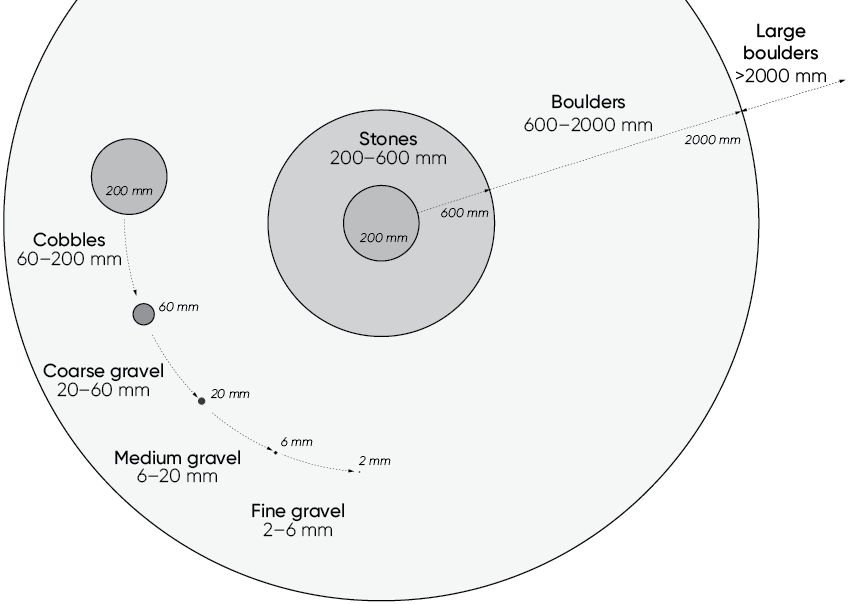
The following classification may be applied to directly measured size data for rock fragments, or used when assessing rock fragment composition in detail (Section 12.2.1).
| Code | Name | Size range (mm) |
|---|---|---|
| 1 | Fine gravel | 2–6 |
| 2 | Medium gravel | 6–20 |
| 3 | Coarse gravel | 20–60 |
| 4 | Cobbles | 60–200 |
| 5 | Stones | 200–600 |
| 6 | Boulders | 600–2,000 |
| 7 | Large boulders | >2,000 |
D.2.2 Abundance classes
D.2.2.1 Abundance classes for roots
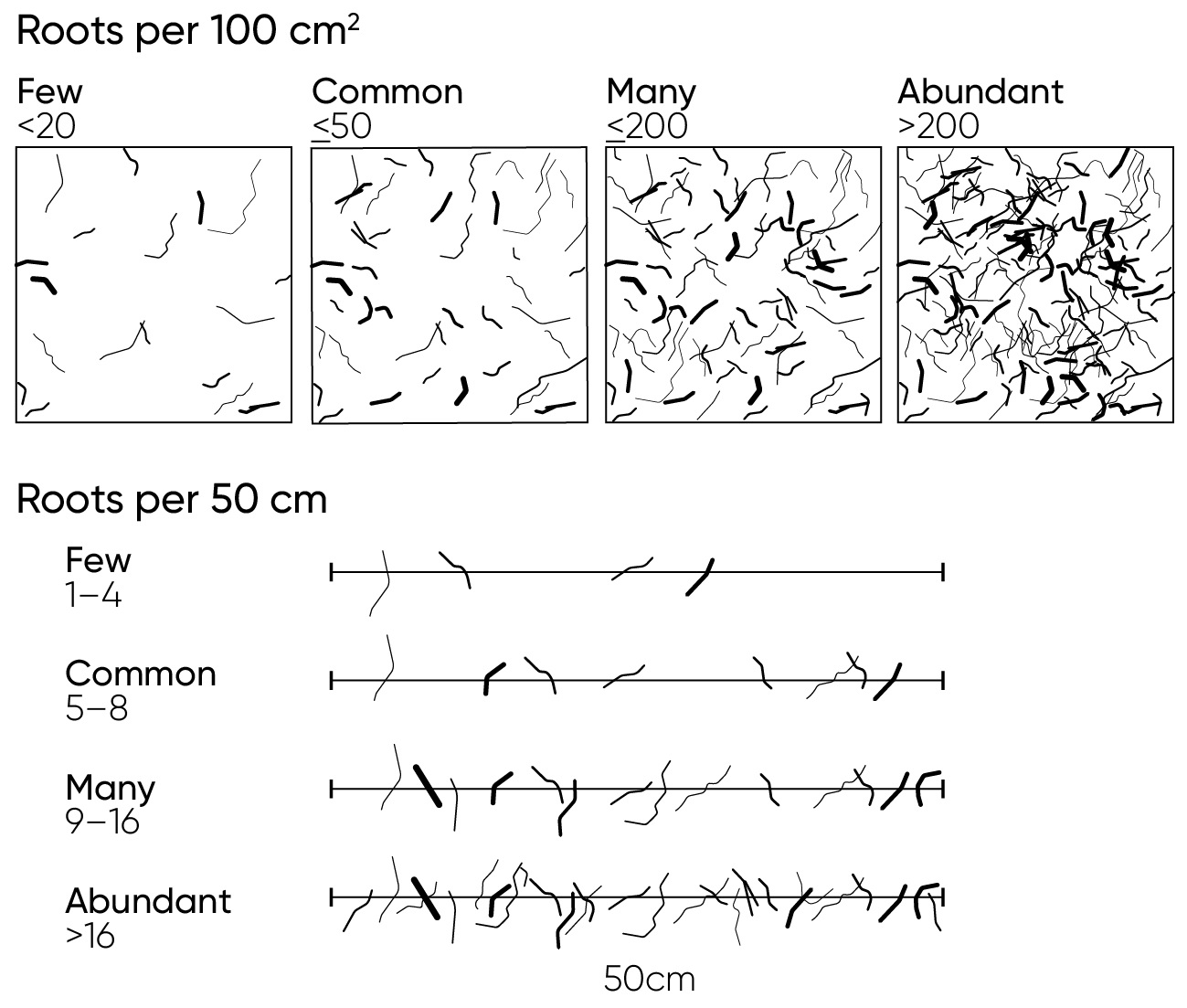
See Section 12.3.1 for assessment methodology.
| Code | Name | Roots per 100 cm2 | Roots per 50 cm transect |
|---|---|---|---|
| 0 | None | 0 | 0 |
| 1 | Few | 1–20 | 1-4 |
| 2 | Common | 21–50 | 5–8 |
| 3 | Many | 51–200 | 9–16 |
| 4 | Abundant | >200 | >16 |
| Source: adapted from International Organization for Standardization (2019). | |||
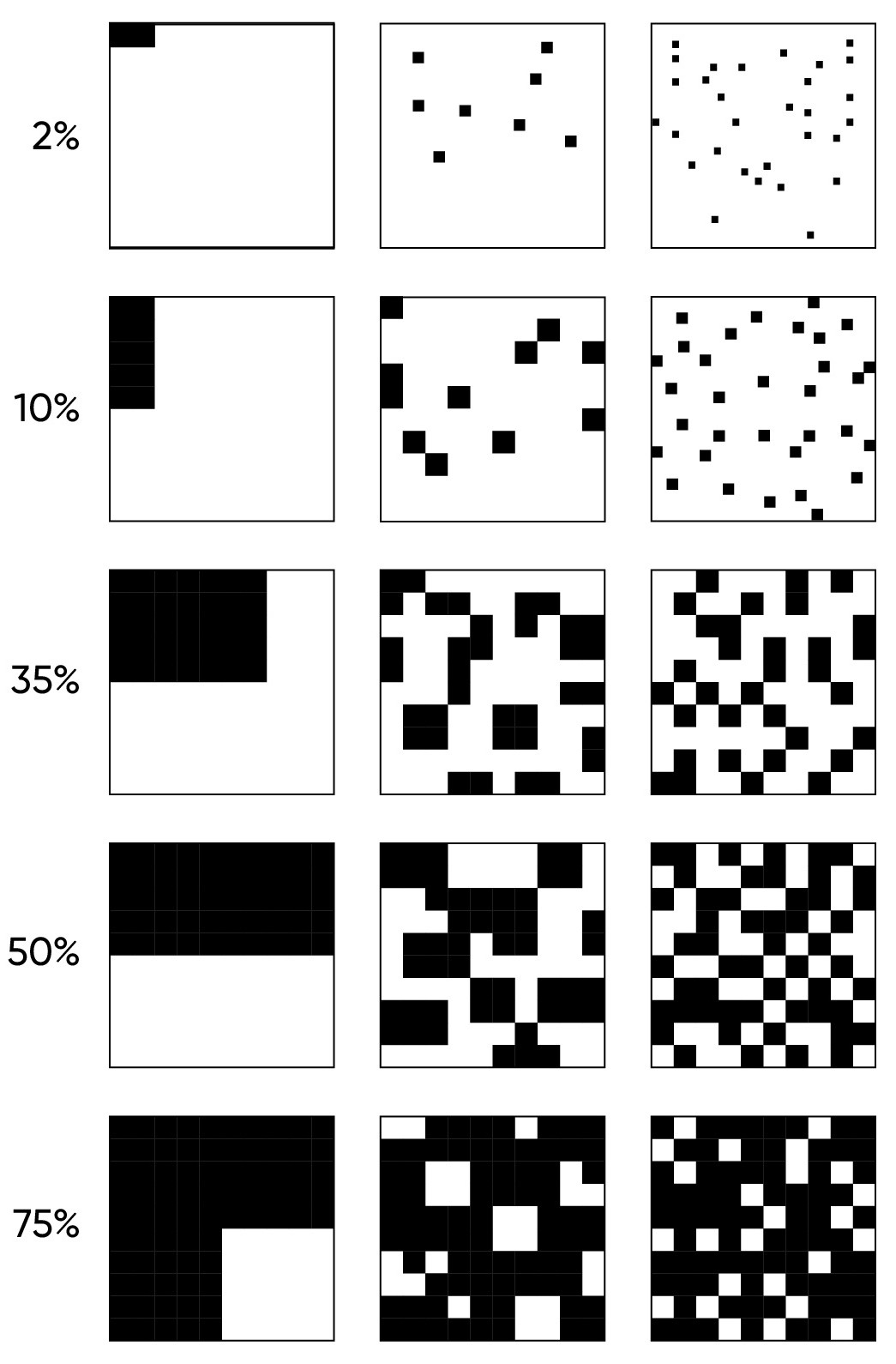
D.2.2.2 Abundance classes for other soil components
| Code | Name | Abundance range (%) |
|---|---|---|
| 0 | None | 0 |
| 1 | Very few | >0–2 |
| 2 | Few | >2–10 |
| 3 | Common | >10–35 |
| 4 | Many | >35–50 |
| 5 | Abundant | >50–75 |
| 6 | Dominant | >75 |